
Melonex Ingredients: The 500 mg Blend, Form by Form, With the Research
Three amino-acid forms, one shared total. Here is what each ingredient is, what the human studies found, and how much of it a Melonex capsule could possibly contain.
The whole formula in one table
Melonex has three active ingredients and three inactive ones. That makes it one of the shortest labels in the blood pressure supplement category, which is a point in its favor: there is nothing hidden among dozens of botanicals. The weakness is elsewhere. All three actives sit inside a single 500 mg "proprietary blend", so the label tells you what is in the capsule but not how much of each.
| Ingredient (label wording) | Per capsule | What it is | Role in the formula | Approx. amino-acid content of the salt |
|---|---|---|---|---|
| L-Citrulline DL-Malate | Part of 500 mg | Citrulline bonded to malic acid | Raises blood arginine via the kidneys | About 50-67% citrulline, depending on ratio |
| L-Arginine (Alpha-Ketoglutarate dihydrate) | Part of 500 mg | Arginine paired with AKG | Direct nitric oxide substrate | Roughly half arginine |
| L-Arginine HCL | Part of 500 mg | Arginine hydrochloride salt | Direct nitric oxide substrate | About 83% arginine |
| Hydroxypropyl methylcellulose | Inactive | Plant-cellulose capsule shell | Holds the powder | Not applicable |
| Microcrystalline cellulose | Inactive | Purified plant fiber | Filler, helps the capsule fill evenly | Not applicable |
| Magnesium stearate | Inactive | Magnesium salt of a fatty acid | Flow agent for the machines | Not applicable |
The ingredient order inside a blend follows weight, from most to least. Citrulline malate comes first, so it is most likely the largest share. That is a sensible choice pharmacologically, as the sections below explain, but the label still leaves the actual numbers unknown.
Three framing points apply to everything on this page. First, all three ingredients act through one pathway, nitric oxide, so the formula is less of a "combination" than its three names suggest. Second, the research on that pathway was done with grams, not milligrams. Third, none of the studies below tested Melonex itself; they tested its ingredients, usually alone.
L-Citrulline DL-malate
What it is
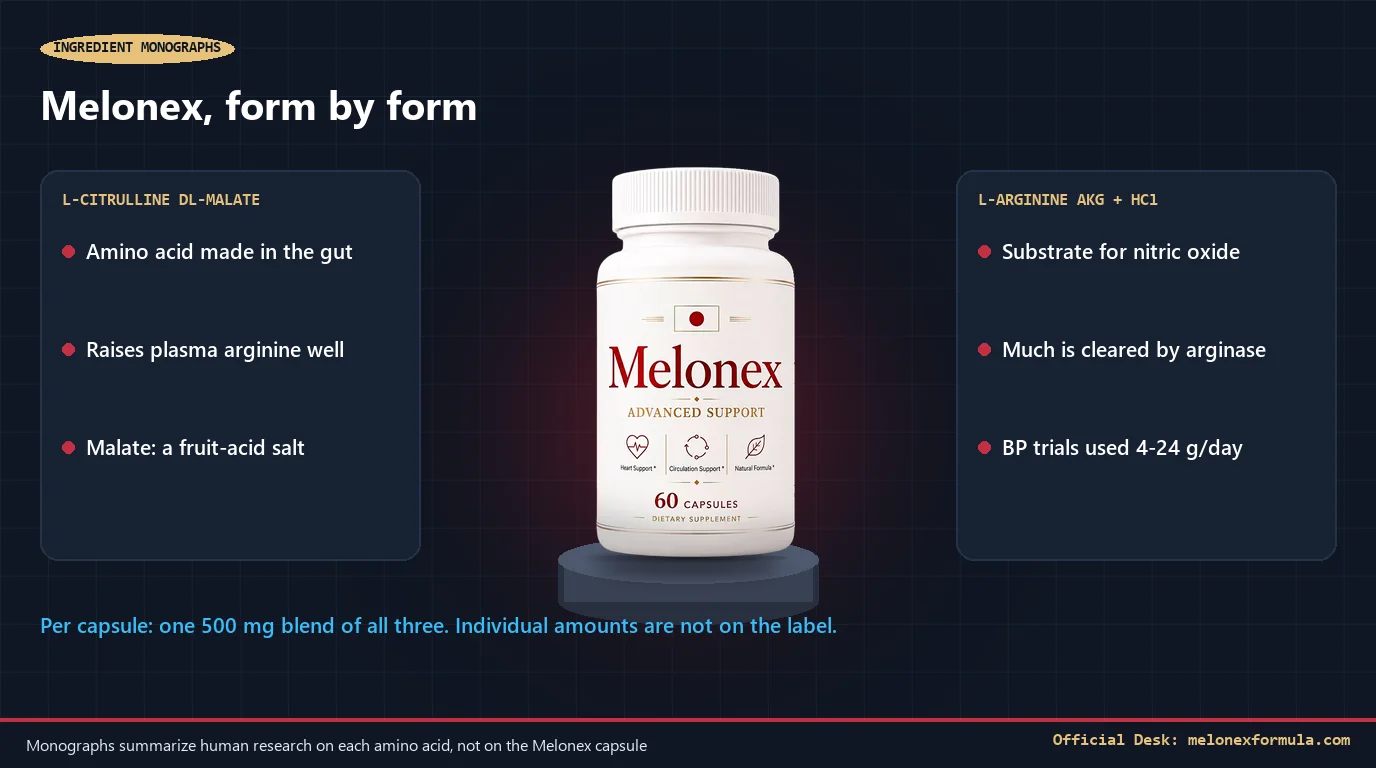
L-citrulline is an amino acid that the body does not use to build proteins. Instead it shuttles nitrogen: cells in the small intestine make citrulline, release it into the blood, and the kidneys convert it into arginine, which then circulates to tissues. Inside blood vessel cells, the same conversion happens locally, recycling the citrulline left over each time nitric oxide is made. Watermelon, especially its pale rind, is the richest common food source, and the name itself comes from Citrullus, the watermelon genus.
"Citrulline malate" is citrulline bonded to malic acid. Commercial citrulline malate is usually sold as 2:1 (two parts citrulline to one part malate) or 1:1. The Melonex label does not say which, and "DL-malate" means the malic acid is a mix of its two mirror-image forms, which is the cheaper industrial version. The citrulline itself is the natural L form.
Why citrulline is the smarter half of the formula
When you swallow arginine, enzymes called arginases in the gut wall and liver break down a large share of it before it reaches the circulation. Citrulline is not a substrate for those enzymes. In a randomized crossover study in 20 healthy volunteers, oral citrulline raised plasma arginine in a dose-dependent way and did so more effectively than oral arginine, while also increasing markers of nitric oxide activity such as urinary nitrate and cyclic GMP[1]. Reviews of citrulline for heart and metabolic health reach the same conclusion: as a way of raising arginine, citrulline is the better route[7][8].
What the human research found
The Citrudose study gave healthy men single doses of 2, 5, 10 and 15 grams. All were well tolerated, without the digestive upset that limits arginine, and plasma arginine rose with dose[2]. In exercise research, 8 grams of citrulline malate taken an hour before training let men complete more repetitions and reduced soreness afterwards[3], and 6 grams a day for a week improved how quickly the body ramped up oxygen use at the start of exercise[4].
For blood pressure the data are thinner. A pilot study gave nine people with prehypertension a watermelon extract that supplied about 2.7 grams of citrulline and 1.3 grams of arginine a day, and found lower aortic systolic pressure and wave reflection after six weeks[5]. A 2019 meta-analysis pooled the small citrulline trials and reported a reduction in systolic pressure; the authors noted short durations and small samples[6].
How the Melonex amount compares
Unknown, because of the blend. The ceiling is clear, though: if the entire 500 mg were citrulline malate in a 2:1 ratio, one capsule would hold about 330 mg of citrulline, and the label maximum of two capsules about 670 mg. Blood pressure and vascular studies typically used 3 to 6 grams, so the best case is roughly a tenth to a fifth of the research range.
L-Arginine alpha-ketoglutarate (dihydrate)
What it is
Arginine alpha-ketoglutarate, usually shortened to AAKG, is a salt of arginine with alpha-ketoglutarate. AKG is an intermediate in the Krebs cycle, the series of reactions cells use to release energy from food, and it also takes part in amino-acid metabolism. In supplements, the pairing is popular mainly because AAKG became a staple of bodybuilding "pump" products in the 2000s. "Dihydrate" means each unit of the crystal carries two water molecules, which adds weight without adding anything active.
What the human research found
The most-cited trial gave 35 resistance-trained men 12 grams of AAKG a day, in three doses, for eight weeks. It was well tolerated and safe on blood tests, and the AAKG group improved one-repetition bench press and sprint peak power slightly more than placebo; it did not change body composition or aerobic capacity[9]. That study measured strength and power, not blood pressure or blood vessel function, and it used about twenty-four times the entire Melonex blend.
No published trial has tested AAKG for blood pressure. Its relevance to Melonex rests on the fact that it delivers arginine, so the arginine evidence below is what applies.
How the Melonex amount compares
Roughly half of AAKG's weight is arginine. If, say, a third of the blend were AAKG, a capsule would supply under 100 mg of arginine from this source. The sales page describes AAKG as "highly-tolerated" and gentle on the stomach; at this size of dose that is true of almost anything.
L-Arginine HCl
What it is
Arginine is one of the twenty amino acids used to build proteins, and the one that nitric oxide synthase uses to make nitric oxide. The body makes some itself, mostly from citrulline, and gets the rest from food: meat, poultry, fish, dairy, nuts, seeds and legumes are all good sources. A typical Western diet supplies several grams a day[13]. Arginine HCl is the hydrochloride salt, stable and inexpensive, and about 83% arginine by weight.
What the human research found
A 2011 meta-analysis pooled 11 randomized, double-blind, placebo-controlled trials with 387 participants. Oral arginine at 4 to 24 grams a day lowered systolic blood pressure by about 5.4 mmHg and diastolic by about 2.7 mmHg compared with placebo[10]. An umbrella review of meta-analyses found consistent support for modest blood pressure reductions and improved endothelial function, the ability of vessel linings to relax[11]. Researchers still debate why extra arginine works at all when the enzyme is normally saturated with it, the so-called "arginine paradox"; competition from a natural inhibitor, ADMA, is one leading explanation[12].
The trial that matters most for safety
VINTAGE MI randomized 153 patients after a heart attack to arginine (3 grams three times a day) or placebo for six months. Arginine did not improve arterial stiffness or heart function, and six patients in the arginine group died compared with none on placebo, so the safety board stopped the trial early[15]. The doses were far higher than Melonex's, and the deaths may have been chance, but the result is the reason anyone with heart disease should involve a cardiologist before taking arginine in any amount.
How the Melonex amount compares
Even if the entire blend were arginine HCl, one capsule would provide about 415 mg of arginine and two capsules about 830 mg. The blood pressure trials used 4,000 to 24,000 mg a day. Next to the several grams already in a normal diet, one capsule adds a modest top-up.
Why the blend matters more than any single ingredient
A proprietary blend is legal: U.S. rules let a company list a blend's total weight and its ingredients in descending order without giving individual amounts. Companies defend blends as protection for their recipe. For buyers, the cost is that you cannot compare the product with research or with competitors.
Melonex shows why this matters. A 500 mg blend split 400/50/50 between citrulline malate, AAKG and arginine HCl is a very different product from one split 100/200/200, yet both would print the same label. The sales page gives each ingredient its own paragraph of benefits ("primary fuel for nitric oxide", "drastic reduction in strain", "immediate relief"), which implies each is present in a meaningful amount. The label cannot confirm that.
| Hypothetical split of 500 mg | Citrulline (approx.) | Arginine (approx.) | Same label? |
|---|---|---|---|
| 400 / 50 / 50 mg | ~265 mg | ~65 mg | Yes |
| 250 / 125 / 125 mg | ~165 mg | ~165 mg | Yes |
| 170 / 165 / 165 mg | ~115 mg | ~220 mg | Yes |
Assumes 2:1 citrulline malate, AAKG at about 50% arginine and arginine HCl at about 83%. Illustrative only; the real split is not published.
What you can say with confidence: whatever the split, one capsule supplies well under half a gram of the amino acids themselves. If you want the maker to settle it, ask [email protected] for the amount of each blend ingredient per capsule or for the certificate of analysis for your lot.
The inactive ingredients
Hydroxypropyl methylcellulose (HPMC) is the capsule shell, made from plant cellulose. It suits vegetarians and vegans, though the label does not make a vegan claim. Microcrystalline cellulose is purified wood or cotton fiber used as a filler so that each capsule fills to the same weight. Magnesium stearate is a common flow agent in very small amounts; online claims that it blocks absorption are not supported by evidence.
No colors, sugars, sweeteners, gluten sources, soy, dairy or shellfish are listed. The label does not carry an allergen statement, which is consistent with none of the major allergens being present, but it also makes no "free from" claims. If you have a severe allergy, confirm with the maker.
What is not in Melonex
It is useful to know what a blood pressure supplement does not contain, because the category is crowded with ingredients that have different evidence. Melonex has none of the following:
- Dietary nitrate (beetroot juice or extract), the other main route to nitric oxide, studied in hundreds of milligrams of nitrate a day.
- Potassium, which helps offset the effect of sodium on blood pressure and is part of the DASH eating pattern.
- Magnesium at a meaningful dose (the stearate is a trace flow agent).
- Hibiscus, garlic, hawthorn, olive leaf or CoQ10, botanicals and nutrients with their own small blood pressure literatures.
- Stimulants such as caffeine or yohimbe, which is a plus for a blood pressure product.
This is not a criticism in itself; a focused formula is easier to evaluate. It does mean Melonex's case rests entirely on the citrulline and arginine evidence, and therefore on the dose question.
Ingredient safety in one place
At the amounts in Melonex, citrulline and arginine are well within normal dietary exposure. Arginine's classic side effects, nausea, cramps, bloating and diarrhea, appear at single doses of several grams[14]; citrulline is better tolerated even at high doses[2]. The interactions to take seriously are pharmacological rather than dose-related: nitrates and PDE5 inhibitors such as sildenafil already act on the nitric oxide pathway and must not be combined with each other[16], blood pressure medicines can add to any lowering effect, and arginine after a heart attack has the VINTAGE MI result against it[15]. As with any supplement, the company, not the FDA, is responsible for safety before sale[17]. The safety page covers each point in depth.
Questions on this topic
Which Melonex ingredient matters most?
L-citrulline, for two reasons: it is listed first in the blend, so it is probably the largest share, and it raises blood arginine more efficiently than arginine itself because it avoids breakdown in the gut and liver.
Why does Melonex use two forms of arginine?
The label does not explain it. AAKG is popular in sports products and arginine HCl is the form used in many blood pressure trials. Both deliver arginine; neither has evidence of acting faster or more strongly than the other.
Is citrulline malate the same as citrulline?
No. Citrulline malate is citrulline bonded to malic acid, so part of its weight is malate. In a 2:1 product about two thirds is citrulline; in a 1:1 product about half.
How much arginine do I already get from food?
Several grams a day on a typical diet, from meat, poultry, fish, dairy, nuts, seeds and legumes. One Melonex capsule adds a few hundred milligrams at most.
Are the ingredients vegan?
The capsule shell is plant cellulose and the amino acids are usually made by fermentation, but the label makes no vegan claim. Ask the maker if it matters to you.
Can I get the same ingredients more cheaply?
Plain L-citrulline and L-arginine powders are widely sold, and a research-sized citrulline serving often costs about what one Melonex capsule does. Check with your clinician before taking gram doses, especially if you take any heart or blood pressure medicine.
Sources for this page
Every entry links to the original record. The trials used single amino acids, usually at several grams a day; none of them tested the Melonex capsule.
- 1Schwedhelm E, Maas R, Freese R, et al. Pharmacokinetic and pharmacodynamic properties of oral L-citrulline and L-arginine: impact on nitric oxide metabolism. Br J Clin Pharmacol. 2008;65(1):51-59. pubmed.ncbi.nlm.nih.gov/17662090/
- 2Moinard C, Nicolis I, Neveux N, et al. Dose-ranging effects of citrulline administration on plasma amino acids and hormonal patterns in healthy subjects: the Citrudose pharmacokinetic study. Br J Nutr. 2008;99(4):855-862. pubmed.ncbi.nlm.nih.gov/17953788/
- 3Perez-Guisado J, Jakeman PM. Citrulline malate enhances athletic anaerobic performance and relieves muscle soreness. J Strength Cond Res. 2010;24(5):1215-1222. pubmed.ncbi.nlm.nih.gov/20386132/
- 4Bailey SJ, Blackwell JR, Lord T, et al. L-Citrulline supplementation improves O2 uptake kinetics and high-intensity exercise performance in humans. J Appl Physiol. 2015;119(4):385-395. pubmed.ncbi.nlm.nih.gov/26023227/
- 5Figueroa A, Sanchez-Gonzalez MA, Perkins-Veazie PM, Arjmandi BH. Effects of watermelon supplementation on aortic blood pressure and wave reflection in individuals with prehypertension: a pilot study. Am J Hypertens. 2011;24(1):40-44. pubmed.ncbi.nlm.nih.gov/20616787/
- 6Barkhidarian B, Khorshidi M, Shab-Bidar S, Hashemi B. Effects of L-citrulline supplementation on blood pressure: a systematic review and meta-analysis. Avicenna J Phytomed. 2019;9(1):10-20. pubmed.ncbi.nlm.nih.gov/30788274/
- 7Allerton TD, Proctor DN, Stephens JM, et al. L-Citrulline supplementation: impact on cardiometabolic health. Nutrients. 2018;10(7):921. pubmed.ncbi.nlm.nih.gov/30029482/
- 8Khalaf D, Kruger M, Wehland M, Infanger M, Grimm D. The effects of oral L-arginine and L-citrulline supplementation on blood pressure. Nutrients. 2019;11(7):1679. pubmed.ncbi.nlm.nih.gov/31336573/
- 9Campbell B, Roberts M, Kerksick C, et al. Pharmacokinetics, safety, and effects on exercise performance of L-arginine alpha-ketoglutarate in trained adult men. Nutrition. 2006;22(9):872-881. pubmed.ncbi.nlm.nih.gov/16928472/
- 10Dong JY, Qin LQ, Zhang Z, et al. Effect of oral L-arginine supplementation on blood pressure: a meta-analysis of randomized, double-blind, placebo-controlled trials. Am Heart J. 2011;162(6):959-965. pubmed.ncbi.nlm.nih.gov/22137067/
- 11McRae MP. Therapeutic benefits of L-arginine: an umbrella review of meta-analyses. J Chiropr Med. 2016;15(3):184-189. pubmed.ncbi.nlm.nih.gov/27660594/
- 12Boger RH. The pharmacodynamics of L-arginine. J Nutr. 2007;137(6 Suppl 2):1650S-1655S. pubmed.ncbi.nlm.nih.gov/17513442/
- 13Wu G, Meininger CJ. Arginine nutrition and cardiovascular function. J Nutr. 2000;130(11):2626-2629. pubmed.ncbi.nlm.nih.gov/11053497/
- 14Grimble GK. Adverse gastrointestinal effects of arginine and related amino acids. J Nutr. 2007;137(6 Suppl 2):1693S-1701S. pubmed.ncbi.nlm.nih.gov/17513449/
- 15Schulman SP, Becker LC, Kass DA, et al. L-arginine therapy in acute myocardial infarction: the Vascular Interaction With Age in Myocardial Infarction (VINTAGE MI) randomized clinical trial. JAMA. 2006;295(1):58-64. pubmed.ncbi.nlm.nih.gov/16391217/
- 16MedlinePlus (U.S. National Library of Medicine). Sildenafil: Drug Information. medlineplus.gov/druginfo/meds/a699015.html
- 17U.S. Food and Drug Administration. Questions and Answers on Dietary Supplements. www.fda.gov/food/information-consumers-using-dietary-supplements/questions-and-answers-dietary-supplements
Ready to run a fair 60-day Melonex trial?
Orders finish on the maker's BuyGoods checkout. Keep a morning blood pressure log, and if the numbers do not move, email support before day 60: opened and empty bottles both qualify.